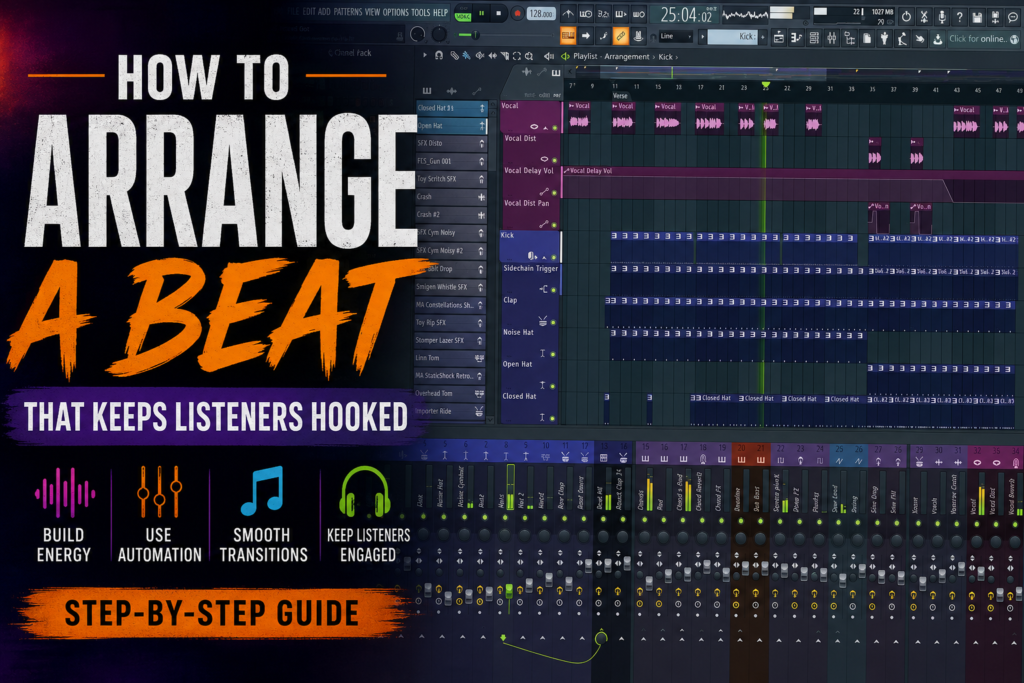
 How To Arrange a Beat That Keeps Listeners Hooked (Step-by-Step Guide)
Creating a great 8-bar loop is exciting, but finishing a complete beat is where many producers get stuck. You’ve probably experienced it yourself: the drums hit hard, the chords sound beautiful, the melody feels perfect—and then you have no idea how to turn those eight bars into a three-minute record.
The good news is that beat arrangement isn’t about making everything more complicated. It’s about creating movement, building anticipation, and keeping listeners engaged from the first second to the last.
In this guide, you’ll learn how to arrange a beat step by step, using techniques that work for hip-hop, trap, R&B, and melodic rap. Whether you’re producing beats for BeatStars, YouTube, or artists, these strategies will help you finish more music and create songs that people actually want to hear.
Why Beat Arrangement Matters
A great loop can grab someone’s attention, but arrangement is what keeps them listening.
Think of your favorite songs. They don’t repeat the exact same eight bars over and over. Instead, they evolve. Instruments enter and leave. Drums change. Energy rises and falls. Every section serves a purpose.
A strong arrangement helps you:
- Prevent your beat from sounding repetitive
- Build excitement throughout the song
- Highlight important moments like hooks
- Give artists room to perform
- Increase the perceived quality of your production
The goal isn’t to add more sounds—it’s to make every sound count.
Start With a Strong 8-Bar Loop
Every great arrangement starts with a solid foundation.
Before arranging anything, make sure your main loop includes:
- Drums
- Bass or 808
- Chords
- Main melody
- Supporting instruments
- Basic effects
If the loop sounds weak, arranging won’t fix it.
Spend your time making those first eight bars sound incredible before moving on.
Understand the Basic Beat Structure
While every genre is different, most modern hip-hop and R&B beats follow a similar layout.
Intro (4–8 Bars)
The intro sets the mood.
Instead of introducing every instrument immediately, begin with:
- Chords only
- A filtered melody
- Ambient textures
- Vocal chops
- FX
This creates anticipation before the drums arrive.
Verse (16 Bars)
The verse should leave space for vocals.
Rather than stacking every instrument together, simplify the arrangement.
Good verse ideas include:
- Basic drum groove
- Chords
- 808
- One lead melody
- Minimal percussion
Artists appreciate space to tell their story.
Hook (8 Bars)
This is your biggest moment.
The chorus should feel larger than the verse.
Ways to increase energy include:
- Bring back all melodies
- Add percussion
- Introduce counter melodies
- Layer extra hi-hats
- Increase automation
- Use crashes and impacts
The listener should instantly recognize the hook.
Bridge (8 Bars)
A bridge gives listeners something unexpected.
Try:
- Removing the drums
- Changing the chords
- Introducing a new melody
- Using halftime drums
- Filtering the entire mix
Even small changes refresh the beat.
Outro (4–8 Bars)
Don’t end abruptly.
Gradually remove elements until only the main atmosphere remains.
Simple outros sound professional and give artists room for fades.
Create Energy With Subtraction
One of the biggest mistakes new producers make is adding more instruments every few bars.
Professional producers often do the opposite.
Instead of constantly adding sounds, remove them.
For example:
Bars 1–8:
- Chords
- Melody
- Drums
- 808
Bars 9–16:
- Remove the melody
- Keep drums and bass
Bars 17–24:
- Bring the melody back
- Add percussion
Bars 25–32:
- Remove the kick
- Add a filter sweep
The contrast creates excitement.
Remember:
Silence can be just as powerful as sound.
Change Something Every 4–8 Bars
One of the easiest ways to keep listeners engaged is to introduce a small variation every few bars.
These changes don’t have to be dramatic.
Ideas include:
- New hi-hat pattern
- Snare fill
- Open hat
- Crash cymbal
- Reverse cymbal
- Short vocal chop
- Automation sweep
- Temporary mute
- New percussion layer
Tiny changes prevent your beat from feeling repetitive.
Use Automation to Add Movement
Automation is one of the easiest ways to make a beat sound expensive.
Instead of letting sounds remain static, automate them throughout the arrangement.
Useful parameters include:
- Filter cutoff
- Volume
- Reverb
- Delay
- Stereo width
- Pan
- Distortion
Even subtle automation makes your production feel alive.
Build Better Transitions
Transitions connect each section naturally.
Without them, your beat can feel like several disconnected loops.
Popular transition effects include:
- Reverse crashes
- Risers
- Downlifters
- White noise
- Impact hits
- Tape stops
- Vinyl stops
- Drum fills
Think of transitions as road signs guiding the listener through the song.
Add Ear Candy
Ear candy refers to small details that listeners may not consciously notice but that make a beat feel polished.
Examples include:
- Background vocal chops
- Short synth stabs
- Reverse piano notes
- FX sweeps
- Percussion fills
- Texture layers
- Glitch effects
- Ambient sounds
Don’t overdo it.
One tasteful element every few bars often has more impact than adding ten new instruments.
Leave Room for the Artist
Many producers make beats that sound incredible on their own but leave no room for vocals.
If you’re selling beats or working with artists, remember that the vocal is usually the main instrument.
Ask yourself:
- Is there enough space?
- Is the melody too busy?
- Are multiple instruments fighting for attention?
- Does the beat support the artist instead of competing with them?
Sometimes removing a single instrument makes the entire beat stronger.
Common Beat Arrangement Mistakes
Repeating the Same Loop
Listeners lose interest quickly when nothing changes.
Too Many Instruments
More sounds rarely mean a better beat.
No Dynamic Contrast
Every section shouldn’t have the same energy level.
Weak Transitions
Abrupt changes can make even great beats feel unfinished.
Ignoring the Artist
Always imagine someone recording vocals over your production.
A Simple Beat Arrangement Template
If you’re unsure where to start, use this proven structure:
- Intro – 8 bars
- Verse – 16 bars
- Hook – 8 bars
- Verse – 16 bars
- Hook – 8 bars
- Bridge – 8 bars
- Final Hook – 16 bars
- Outro – 8 bars
This template works across hip-hop, trap, R&B, melodic rap, and pop.
As you gain experience, you’ll naturally begin creating more unique arrangements.
Final Thoughts
Learning how to arrange a beat is one of the biggest steps toward becoming a complete producer.
You don’t need dozens of instruments or complicated techniques. The best arrangements rely on contrast, movement, and intentional choices.
Focus on making small changes every few bars, using subtraction to create dynamics, and giving artists room to shine. The more complete beats you finish, the faster your arrangement skills will improve.
Remember, a finished beat always has more value than another unfinished loop sitting on your hard drive.
So open your favorite DAW, load up one of your eight-bar ideas, and challenge yourself to turn it into a complete song today. Every finished beat is another step toward becoming the producer you want to be.