 Have you ever played a chord progression that looked great on paper but sounded stiff or amateur when you played it?
If so, the problem might not be the chords themselves—it might be how you’re playing them.
One of the biggest differences between beginner and professional producers is the use of chord inversions. Instead of jumping around the keyboard in root position, experienced producers rearrange the notes within each chord to create smoother transitions, richer harmonies, and more emotional progressions.
Whether you’re making hip-hop, trap, R&B, lo-fi, or pop, learning chord inversions can instantly elevate your beats without learning dozens of new chords.
In this guide, you’ll learn what chord inversions are, why they matter, and how to use them to create more polished, professional productions.
What Is a Chord Inversion?
A chord inversion is simply a chord where a note other than the root is played as the lowest note.
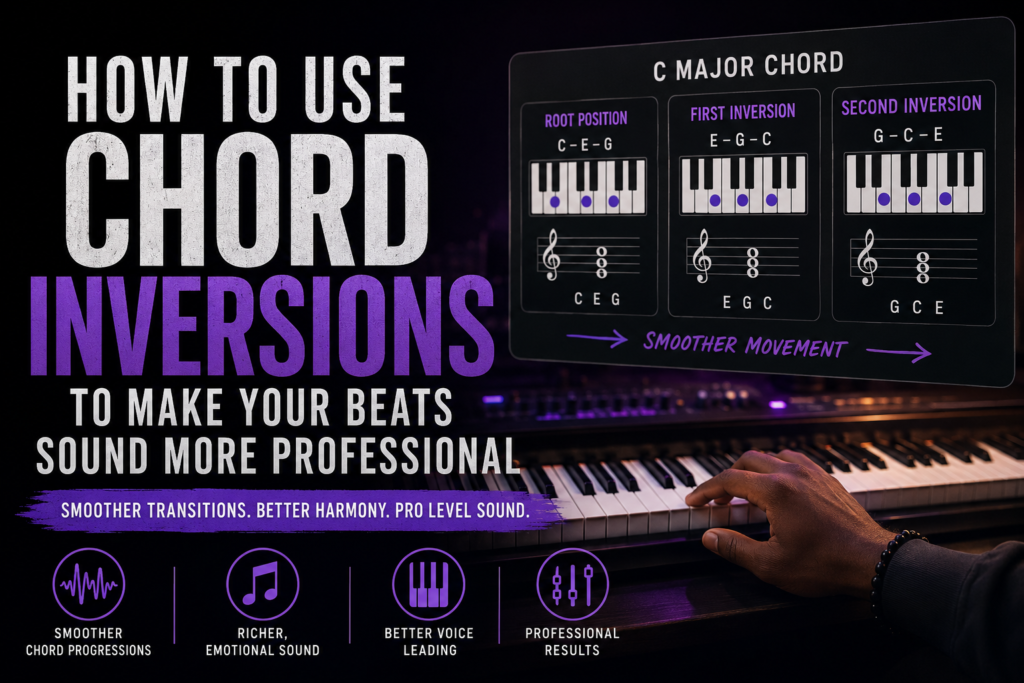
Let’s look at a simple C major chord.
Root Position
C – E – G
Move the C to the top, and you get the first inversion:
E – G – C
Move the E to the top:
G – C – E
That’s the second inversion.
The chord is still C major. The notes haven’t changed—only their order.
That small change can dramatically affect how your progression feels.
Why Chord Inversions Matter
Professional producers rarely play every chord in root position.
Instead, they choose inversions that keep the movement between chords as smooth as possible.
This creates:
- Smoother chord transitions
- More emotional progressions
- Less clutter in the arrangement
- Better voice leading
- A more polished, expensive sound
If you’ve ever wondered why your favorite R&B or neo-soul records feel so fluid, chord inversions are a big part of the answer.
Root Position vs. Inversions
Imagine you’re playing this progression:
C – Am – F – G
If every chord is played in root position, your hands jump all over the keyboard.
Now use inversions so each chord stays close to the previous one.
Instead of large leaps, your fingers only move a note or two between chords.
The progression suddenly sounds smoother and more connected.
That’s called voice leading, and it’s one of the hallmarks of professional chord writing.
Understanding Voice Leading
Voice leading is the practice of moving each note in a chord as little as possible when changing to the next chord.
Instead of thinking about entire chords, think about individual notes.
Ask yourself:
“Can this note stay where it is?”
“Can this note move only one step?”
The less movement, the smoother your progression will sound.
This technique is used in everything from gospel and jazz to modern R&B and cinematic film scores.
Using Chord Inversions in Hip-Hop Beats
Hip-hop often relies on simple progressions with strong melodies.
Chord inversions help those simple progressions sound much richer.
For example:
E Minor Progression
Em – C – G – D
Rather than playing every chord in root position, experiment with inversions that keep your hands in roughly the same area of the keyboard.
The result is a progression that feels more fluid and leaves more room for your drums, bass, and lead melodies.
This is especially effective for emotional and melodic hip-hop.
Chord Inversions for Trap Soul and R&B
If you’re producing artists in the style of Bryson Tiller, The Weeknd, Giveon, or SZA, chord inversions are almost essential.
Modern R&B is built on smooth harmonic movement.
Instead of dramatic jumps between chords, producers often use inversions that create subtle movement and tension.
Pair inversions with:
- Seventh chords
- Ninth chords
- Suspended chords
- Added color tones
Even a simple four-chord progression can sound lush and emotional with the right voicings.
How Inversions Create Space in Your Mix
Chord inversions don’t just improve harmony—they also improve your arrangement.
When chords are spread naturally across the keyboard:
- Bass frequencies stay clean
- Midrange becomes less crowded
- Melodies have more room
- Vocals sit better
- Mixes sound wider
This is one reason professional productions often feel open and spacious even when they contain many instruments.
Common Beginner Mistakes
Playing Everything in Root Position
This is the most common mistake.
If every chord starts on the root note, your progressions may sound rigid and repetitive.
Moving Too Far Across the Keyboard
Large jumps make progressions feel disconnected.
Look for inversions that keep your hands close together.
Ignoring the Bass Line
Remember that changing an inversion changes the lowest note of the chord.
Sometimes that’s exactly what you want.
Other times, you may want your bass instrument to continue playing the original root note while your keyboard uses inversions above it.
This technique creates rich harmony while maintaining a strong foundation.
Making Things Too Complicated
You don’t need advanced jazz harmony to sound professional.
Often, a simple progression with excellent voice leading sounds better than a complex progression played poorly.
Practice Exercise
Try this progression:
Em – C – G – D
Step 1
Play every chord in root position.
Listen carefully.
Step 2
Now experiment with inversions.
Your goal isn’t to find the “correct” answer.
Your goal is to minimize movement between each chord.
Notice how much smoother the progression becomes.
Repeat this exercise with your favorite progressions until finding inversions becomes second nature.
Using Chord Inversions in Any DAW
The beauty of chord inversions is that they work regardless of your software.
Whether you’re producing in:
- Reason
- FL Studio
- Ableton Live
- Logic Pro
- Cubase
- Studio One
…the musical concept stays exactly the same.
You can even use MIDI editing tools to experiment with different inversions after recording your performance.
Don’t be afraid to drag notes up or down an octave until the progression feels natural.
Tips for Better Chord Writing
As you become more comfortable with inversions, combine them with these techniques:
- Add seventh chords for warmth.
- Use ninth chords for color.
- Leave space between the bass and upper voices.
- Double important melody notes an octave higher.
- Listen for smooth movement instead of flashy chord changes.
These small decisions are what give professional productions their polished, emotional sound.
Final Thoughts
Learning chord inversions is one of the fastest ways to improve your beat-making skills. You don’t need expensive plugins or advanced music theory—just a willingness to rethink how you voice your chords.
Start with the progressions you already know. Instead of adding more notes, experiment with moving the existing ones into different positions. You’ll be surprised how much smoother and more expressive your music becomes.
As you grow more comfortable with inversions, you’ll naturally begin writing progressions that sound fuller, more emotional, and more professional. Combined with strong drum programming, tasteful sound selection, and thoughtful arrangement, chord inversions can help transform simple ideas into memorable records.
The next time one of your beats feels like it’s missing something, don’t rush to change the chords. Try changing the way you play them instead—you may discover that the professional sound you’re chasing has been there all along.