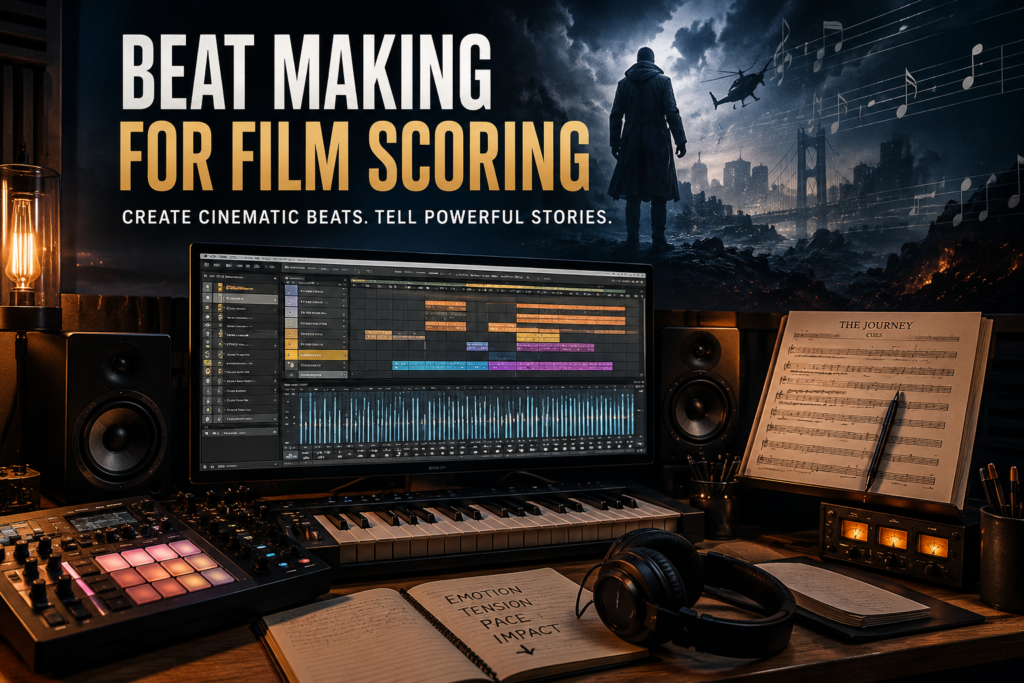
 Film scoring has always been one of the most powerful forms of music production. Long before dialogue explains what a character feels, music often tells the audience first. A rising synth pad can create tension. Deep drums can signal danger. Sparse piano notes can communicate heartbreak without a single spoken word.
For modern producers, beat-making for film scoring has become an exciting intersection between traditional composition and contemporary production. Today’s film scores are no longer limited to orchestras and classical arrangements. Producers now blend hard-hitting drums, 808s, cinematic percussion, ambient textures, and experimental sound design to create unforgettable sonic experiences.
Whether you’re producing for short films, YouTube content, commercials, games, or Hollywood productions, understanding how beats function in cinematic storytelling can elevate your skills as a producer.
Introduction to Beat Making for Film Scoring
Defining the Unique Role of Beats in Storytelling Through Films
In traditional beat production, the goal may be to create something catchy, rhythmic, and memorable for artists or listeners. In film scoring, the objective shifts. The beat becomes part of the narrative.
A cinematic beat doesn’t simply provide rhythm—it supports emotion, pacing, tension, and movement. Every kick, snare, percussion hit, and bass pulse can influence how viewers interpret a scene.
Imagine an action sequence with no percussion. It would feel lifeless. Now imagine a suspense scene with heavy trap drums—it might feel completely out of place. Context matters.
Film beats serve storytelling first.
Why Beats Are More Than Background Music
Many beginner producers think film music sits quietly in the background. In reality, it often acts as an invisible emotional guide.
Beats can:
- Increase suspense
- Build anticipation
- Intensify action
- Emphasize emotional transitions
- Highlight dramatic reveals
When used effectively, audiences may not consciously notice the beat, but they absolutely feel its impact.
A slow pulse can make a scene feel uneasy. Rapid percussion can make the heart race. Silence followed by impact can shock the audience.
That is the power of cinematic rhythm.
Historical Evolution: From Analog to Digital
Film scoring has transformed dramatically over the decades.
Early composers relied on full orchestras recorded in large studios. Legends like John Williams and Hans Zimmer helped define the cinematic sound many people recognize today.
Then technology changed everything.
Analog synthesizers introduced new textures. Drum machines created mechanical rhythms. Samplers enabled composers to trigger realistic orchestral sounds from a keyboard.
Today, producers can build entire film scores from a laptop using DAWs, plugins, virtual instruments, and sample libraries. The barrier to entry has never been lower.
Key Principles of Beat Making for Film Scoring
Understanding Narrative Pacing and Rhythm
Every scene has pacing.
Some scenes move fast. Others breathe slowly. Your beat must support that pacing.
Ask yourself:
- Is this scene tense or relaxed?
- Does the energy rise or fall?
- Is the audience meant to feel comfort, fear, urgency, or mystery?
A chase scene may need aggressive percussion and fast rhythmic layers.
A dramatic conversation may only need subtle low-end pulses.
The beat should move with the story—not against it.
Genre Matters: Beats Across Film Styles
Different genres require different rhythmic approaches.
Action
Action films often rely on:
- Heavy percussion
- Big impacts
- Hybrid orchestral drums
- Pulsing bass
These beats create momentum and adrenaline.
Suspense / Thriller
Suspense often uses:
- Sparse percussion
- Low-frequency pulses
- Irregular rhythms
- Disturbing textures
Unpredictability creates tension.
Sci-Fi
Sci-fi scores frequently feature:
- Synthetic textures
- Glitch percussion
- Atmospheric layers
- Experimental rhythms
This creates a futuristic sonic world.
Drama
Dramatic films may use:
- Minimal drums
- Soft piano pulses
- Organic percussion
- Emotional ambience
Subtlety becomes the focus.
The Psychology of Sound
Humans respond emotionally to rhythm.
Fast beats raise excitement.
Slow beats can feel reflective or ominous.
Low frequencies trigger physical reactions because we feel bass in our bodies. High frequencies can create alertness or anxiety.
This psychological connection is why beat making for film scoring requires emotional awareness—not just technical skill.
A great cinematic producer understands both music and human emotion.
Tools and Technologies for Making Film Beats
Top DAWs Used in Film Scoring
The modern film producer has access to powerful software.
Popular DAWs include:
- Ableton Live — Great for creative sound manipulation and hybrid scoring
- FL Studio — Excellent for beat programming and sequencing
- Logic Pro — Popular for composers due to built-in orchestral tools
- Pro Tools — Industry standard for post-production
- Cubase — Highly respected among film composers
- Reason — Excellent for creative routing, sound design, and unique textures
Each DAW has strengths, but the best one is the one that supports your workflow.
Sampling, Sequencing, and Sound Design
Three core skills define modern cinematic beat makers.
Sampling
Sampling allows you to use pre-recorded sounds such as:
- Drums
- Foley
- Orchestral hits
- Impacts
- Vocal textures
Even everyday sounds can become cinematic.
A slammed door can become percussion. A reversed vocal can become tension.
Sequencing
Sequencing means arranging sounds over time.
This includes:
- Drum programming
- Percussion placement
- Transitions
- Tempo automation
- Rhythmic layering
Great sequencing creates movement.
Sound Design
Sound design separates average producers from elite cinematic producers.
This includes:
- Layering synths
- Creating risers
- Designing impacts
- Processing textures with reverb and delay
- Manipulating audio with modulation
Sound design gives your score identity.
Licensing and Sound Libraries
Legal considerations matter.
If you use loops, samples, or sound libraries, verify licensing.
Always ask:
- Can this be used commercially?
- Is attribution required?
- Is sync licensing included?
Ignoring licensing can cause major issues if your music lands in commercial media.
Use reputable libraries and keep documentation.
Crafting Unique Film Beats
Integrating Cultural and Musical Influences
Some of the most memorable film scores blend cultural identity with modern production.
Examples include:
- African percussion
- Middle Eastern scales
- Jazz harmony
- Gospel chords
- Trap drums
- Ambient electronic textures
Blending influences creates originality.
As a producer, your personal musical background can become your competitive advantage.
Creating Themes That Evolve
Strong films often use recurring themes.
A melody introduced early may return later in a transformed form.
For example:
- Soft piano version during emotional scenes
- Aggressive drum-heavy version during conflict
- Massive cinematic version during climax
This creates cohesion across the score.
Think of themes as characters.
They evolve with the story.
Collaborating With Filmmakers
Film scoring is rarely a solo process.
Producers must collaborate with:
- Directors
- Editors
- Sound designers
- Producers
- Music supervisors
Communication is critical.
Ask questions like:
- What emotion should this scene create?
- Where should tension build?
- Should music lead or support the visuals?
The better you understand the filmmaker’s vision, the better your beats will serve the project.
Future Trends in Beat Making for Film Scoring
AI and Machine Learning
Artificial intelligence is rapidly changing music production.
AI tools can now assist with:
- Composition ideas
- Arrangement suggestions
- Sound generation
- Stem separation
- Adaptive scoring
AI won’t replace great producers.
But it will accelerate workflows.
The producers who learn to leverage AI creatively will gain a major advantage.
Immersive Audio for VR and AR
Virtual reality and augmented reality are creating entirely new challenges.
Traditional stereo mixing may not be enough.
Immersive formats such as spatial audio require producers to think in three dimensions.
Sound must move with the user’s perspective.
This changes beat design dramatically.
Producers must consider:
- Distance
- Position
- Motion
- Environmental acoustics
This is one of the biggest frontiers in cinematic audio.
Emerging Genres and New Sonic Landscapes
Music evolves constantly.
Genres like:
- Hyperpop
- Phonk
- Hybrid trap orchestral
- Ambient trap soul
- Experimental electronic
are already influencing modern soundtracks.
Tomorrow’s iconic film scores may sound nothing like today’s.
That creates opportunity.
Final Thoughts
Beat making for film scoring is one of the most exciting disciplines in modern music production. It combines rhythm, emotion, storytelling, sound design, and technology into one creative craft.
The best cinematic producers understand a simple truth:
A beat is never just a beat.
In film, every sound has meaning.
Whether you’re producing inside Reason, FL Studio, or Ableton Live, mastering film beat production requires listening beyond the music and into the story itself.
Learn to serve the narrative, and your beats will become unforgettable.