 If melody is what people sing, rhythm is what makes them move.
At the heart of nearly every song lies a drum pattern—a repeating rhythmic sequence that creates groove, momentum, and energy. Whether you’re producing hip-hop, R&B, trap, pop, rock, or electronic music, understanding drum patterns is one of the most important skills you can develop as a producer.
Drum patterns do more than keep time. They shape the emotional identity of a track. A slow, sparse pattern can feel moody and reflective, while an aggressive, fast-paced rhythm can feel intense and powerful.
For beginner producers, mastering drum patterns is often the first major step toward making professional-sounding beats.
In this guide, we’ll break down what drum patterns are, why they matter, and how you can create better drum grooves in your own productions.
Understanding the Basics: What Are Drum Patterns?
Definition of Drum Patterns and Their Role in Music
A drum pattern is a repeated sequence of drum sounds arranged over a measure or multiple measures to establish rhythm.
Common drum sounds include:
- Kick drum
- Snare drum
- Hi-hats
- Claps
- Toms
- Percussion
- Cymbals
These sounds are placed on a timeline—usually a grid inside a DAW—to create a groove.
Think of drum patterns as the rhythmic skeleton of a song.
Without drums, many songs would feel empty or directionless.
Drum patterns help define:
- Tempo
- Groove
- Energy
- Bounce
- Movement
Even minimal drum programming can dramatically change how a track feels.
A Brief History of Drum Patterns
Drum patterns have existed for thousands of years.
Ancient cultures used percussion for:
- Ceremonies
- Communication
- Celebration
- Storytelling
As music evolved, rhythm became central to nearly every genre.
In the 20th century, acoustic drum kits became foundational in jazz, blues, rock, and funk. Legendary drummers like Clyde Stubblefield and John Bonham helped define iconic grooves that producers still study today.
The digital revolution changed everything.
Drum machines such as the Roland TR-808 and Roland TR-909 became essential in hip-hop, house, techno, and pop.
Today, producers program drums using software, MIDI controllers, and hardware samplers.
Common Types of Drum Patterns by Genre
Different genres emphasize different rhythms.
Hip-Hop
- Strong kicks
- Snappy snares
- Swing-heavy hi-hats
- Groove-focused pocket
Trap
- Hard 808s
- Rapid hi-hat rolls
- Triplets
- Sparse but powerful drums
R&B
- Smooth grooves
- Ghost notes
- Laid-back timing
- Warm percussion
Pop
- Clean, simple rhythms
- Easy-to-follow groove
- Strong backbeat
House / EDM
- Four-on-the-floor kick
- Repetitive groove
- Layered percussion
Each style has its own rhythmic DNA.
Exciting the Senses: The Psychology Behind Drum Patterns
Why Drums and Rhythm Resonate Deeply
Humans naturally respond to rhythm.
Your heartbeat is rhythmic.
Walking is rhythmic.
Breathing is rhythmic.
Because rhythm exists in our biology, drums feel instinctive.
This is why a great groove can make people nod their heads before they even process the melody.
Rhythm speaks directly to the body.
Emotional Impact of Different Drum Patterns
Different drum choices create different emotional responses.
Fast rhythms can feel:
- Energetic
- Urgent
- Exciting
Slow rhythms can feel:
- Relaxed
- Dark
- Reflective
Sparse patterns can create tension.
Dense patterns can create chaos or excitement.
This emotional power makes drums essential for storytelling in music.
How Drum Patterns Shape a Song
Drums influence arrangement and song structure.
They signal transitions between:
- Verse
- Chorus
- Bridge
- Breakdown
- Drop
For example:
- Removing drums can create tension
- Adding percussion can increase energy
- Changing hi-hat rhythm can transform groove
Small changes create big emotional shifts.
Crafting Your Beat: Tools for Creating Drum Patterns
Software and Hardware Tools
Modern producers have countless tools available.
Popular DAWs include:
- FL Studio
- Ableton Live
- Logic Pro
- Reason
- Cubase
Hardware tools include:
- Akai MPC
- MIDI pad controllers
- Drum machines
- Electronic drum kits
Software offers flexibility. Hardware often improves hands-on creativity.
Many producers use both.
Online Resources for Learning Drums
You can accelerate quickly using online resources.
Helpful learning sources include:
- YouTube tutorials
- Producer communities
- Sample packs
- Drum MIDI packs
- Beat breakdown videos
Listening critically to great music is also training.
Study grooves you love.
Ask:
- Where is the kick?
- What gives the groove bounce?
- Why does it feel good?
Step-by-Step: Create a Basic Drum Pattern
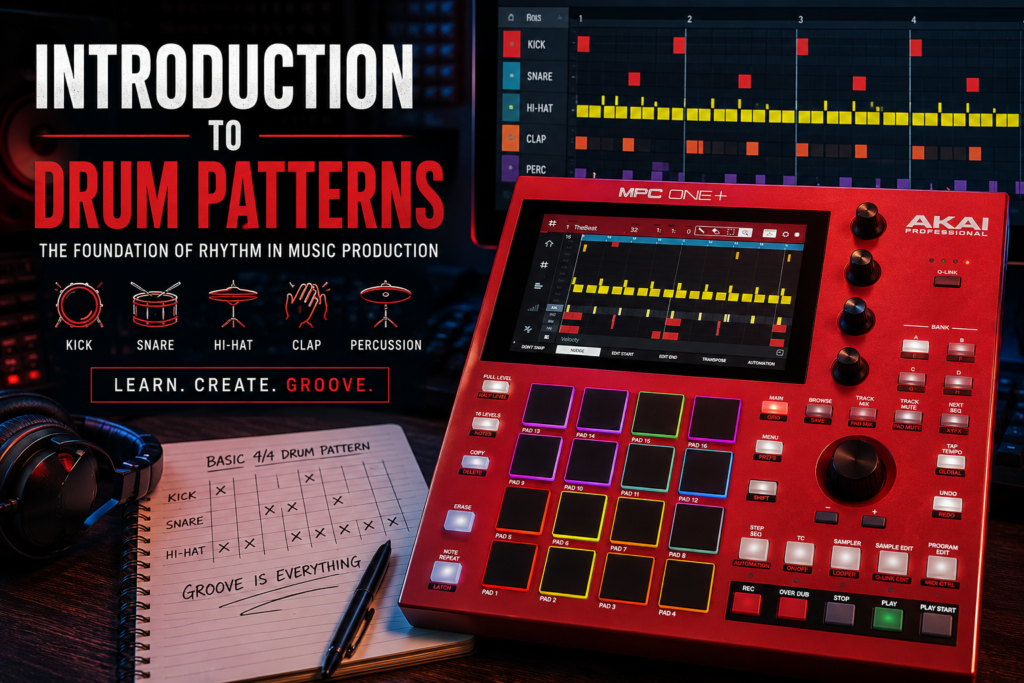
Let’s build a simple 4/4 drum pattern.
Step 1: Add Kick
Place kick drums on:
- Beat 1
- Beat 3
This creates the foundation.
Step 2: Add Snare
Place snares on:
- Beat 2
- Beat 4
This gives a classic backbeat.
Step 3: Add Hi-Hats
Add hi-hats every 1/8 note.
Now the groove starts moving.
Step 4: Add Variation
Try:
- Extra kicks
- Open hats
- Percussion hits
- Rolls
Variation adds personality.
Step 5: Humanize
Shift some notes slightly off-grid.
Perfect timing can feel robotic.
Small imperfections create groove.
Mastering Complexity: Advanced Drum Techniques
Complex Time Signatures
Not all music uses 4/4.
Advanced rhythms may use:
- 3/4
- 5/4
- 7/8
- 9/8
These signatures create unique movement.
They are common in jazz, fusion, progressive rock, and experimental music.
Learning unusual time signatures expands creativity.
Dynamics and Syncopation
Great drum patterns breathe.
Velocity matters.
Not every hit should be equally loud.
Use softer hits for:
- Ghost notes
- Groove
- Feel
- Bounce
Syncopation is also powerful.
Syncopation means emphasizing unexpected beats.
This creates:
- Tension
- Groove
- Swing
- Movement
Many elite producers rely heavily on syncopation.
Technology for Live Performance
Technology has expanded live rhythm creation.
Tools like loop stations let performers build patterns in real time.
Live beat makers often use:
- Samplers
- Loopers
- Drum pads
- Performance sequencers
This blends production with performance.
Artists like FKJ and Tash Sultana showcase how loop-based performances can feel alive and dynamic.
In the Groove: Real-Life Applications and Listening Guide
Iconic Drum Patterns to Study
Some legendary drum grooves every producer should study:
Billie Jean — Michael Jackson
Minimal but unforgettable groove.
In the Air Tonight — Phil Collins
One of the most iconic drum moments ever recorded.
Still D.R.E. — Dr. Dre
Clean, powerful hip-hop drum programming.
Dreams and Nightmares — Meek Mill
Excellent example of energy escalation through drums.
Study these closely.
Learning From Great Drummers
Top drummers often focus on one principle:
Serve the song.
Technical skill matters, but groove matters more.
Great drummers ask:
- What does this song need?
- Where should I leave space?
- How can I enhance emotion?
That mindset also applies to producers.
Recommended Listening
To understand drum patterns deeply, study playlists covering:
- Funk grooves
- Boom bap hip-hop
- Neo-soul
- Trap
- Afrobeat
- House music
- Gospel chops
Each teaches different rhythmic concepts.
Final Thoughts
Drum patterns are the heartbeat of music production.
They provide rhythm, emotion, movement, and identity. Whether you’re programming drums in Reason, building beats on an Akai MPC, or sequencing inside FL Studio, learning how rhythm works will dramatically improve your music.
Start simple.
Master groove.
Then build complexity.
Because in great music, the drums don’t just keep time—they create feeling.