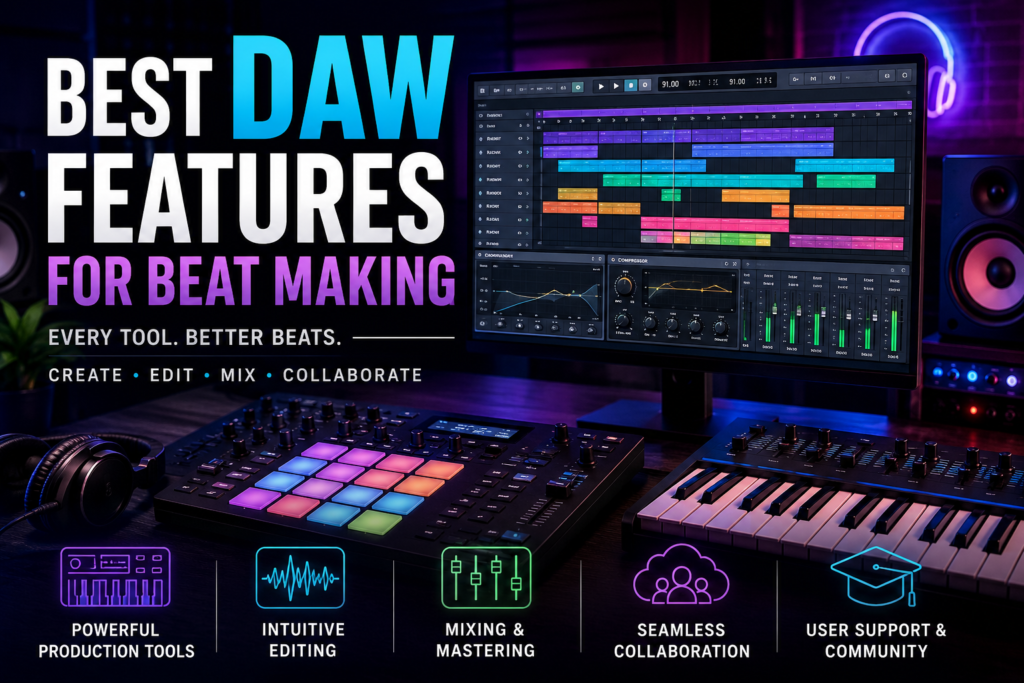
 Choosing the right Digital Audio Workstation (DAW) can make or break your beat-making workflow. While every producer has personal preferences, the best DAWs share one thing in common: they provide powerful tools that help you create, arrange, mix, and finish music efficiently.
Whether you produce hip-hop, trap, R&B, drill, or electronic music, certain DAW features are essential for professional-level beat production. From advanced drum programming to intuitive editing and collaboration tools, modern DAWs offer more creative power than ever before.
In this guide, we’ll break down the most important DAW features every beat maker should look for in 2026.
Powerful Production Tools
The foundation of any great beat starts with the tools available inside your DAW. A strong DAW should make it easy to build melodies, program drums, and experiment with sounds.
Instrument Plugins and Sample Packs for Hip-Hop Production
Virtual instruments are at the heart of modern beat-making. High-quality plugins allow producers to access realistic pianos, synths, basses, strings, and experimental textures without expensive hardware.
Popular plugin categories include:
- Synth plugins for melodies and pads
- Piano and keyboard instruments for chord progressions
- Bass plugins for 808s and low-end design
- Orchestral libraries for cinematic production
- Sample packs with drums, loops, and one-shots
Many producers rely on plugin ecosystems like Native Instruments Kontakt, Serum, and Omnisphere for premium sound design.
The better your sound sources, the easier it becomes to create industry-ready beats.
The Importance of MIDI Controllers
A DAW becomes even more powerful when paired with a MIDI controller.
Common benefits include:
- Faster melody creation
- Hands-on drum programming
- Improved musical expression
- Better workflow for chord building
Controllers such as pad-based samplers or keyboard controllers let producers move beyond clicking notes with a mouse.
For many beat makers, physical interaction leads to more natural grooves and better creative flow.
Advanced Drum Programming Tools
Drums define the groove.
Your DAW should make drum programming easy and flexible.
Important features include:
- Step sequencers
- Piano roll editing
- Velocity editing
- Swing controls
- Humanization tools
- Probability/randomization features
These tools help create diverse rhythms, especially in genres like trap where hi-hat rolls, ghost notes, and bounce are critical.
Modern DAWs like FL Studio and Ableton Live excel in drum sequencing.
Intuitive Editing Capabilities
Even amazing loops can feel repetitive without proper arrangement and editing.
A strong DAW helps you shape ideas into complete songs.
Non-Linear Editing for Flexible Arrangements
Non-linear editing allows producers to move sections around without destructive changes.
This makes it easier to:
- Rearrange verses and hooks
- Duplicate sections
- Build transitions
- Experiment with song structure
Instead of committing too early, you can test multiple arrangements quickly.
This flexibility encourages creativity and helps overcome beat block.
Automation for Dynamic Beat-Making
Automation is one of the most powerful tools in music production.
It allows parameters to change over time.
Common automation targets include:
- Volume
- Filter cutoff
- Reverb amount
- Delay feedback
- Stereo width
- Distortion intensity
Automation adds movement and emotion.
For example, automating a low-pass filter before a drop creates tension and anticipation.
Small changes can dramatically improve a beat.
Clip Launching for Spontaneous Creativity
Clip launching is especially useful for producers who enjoy improvisation.
This workflow allows you to trigger loops and patterns in real time.
Benefits include:
- Fast idea generation
- Live experimentation
- Performance-based production
- Better loop testing
DAWs like Ableton Live are famous for this workflow.
For producers who think musically rather than linearly, clip launching can feel revolutionary.
Mixing and Mastering Mastery
Making a beat is only half the process.
Mixing and mastering help turn raw ideas into polished records.
Built-In EQs, Compressors, and Limiters
A great DAW includes quality stock plugins.
Core mixing tools should include:
- EQ
- Compression
- Saturation
- Limiting
- Delay
- Reverb
These tools shape tone, control dynamics, and create depth.
Stock plugins in modern DAWs are better than ever, often rivaling premium third-party plugins.
Third-Party Plugins for Enhanced Sound Quality
Third-party plugins offer specialized processing and character.
Popular categories include:
- Analog emulations
- Surgical EQs
- Multiband compression
- Tape saturation
- Mastering suites
Many professional producers use plugins from FabFilter, Soundtoys, and iZotope.
These tools help achieve cleaner mixes and more competitive masters.
Sidechain Compression for Punchier Beats
Sidechain compression is essential in modern production.
It allows one sound to duck another.
Common uses:
- Kick ducking bass or 808
- Vocals cutting through instruments
- Creating pump in EDM and trap
Benefits include:
- Better punch
- Cleaner low end
- Improved groove
- More headroom
When used correctly, sidechaining creates clarity without sacrificing power.
Seamless Collaboration Features
Music production is increasingly collaborative.
Modern DAWs support remote workflows better than ever.
Cloud-Based Projects
Cloud storage makes collaboration easier.
Benefits include:
- Access projects anywhere
- Backup sessions automatically
- Share sessions instantly
- Reduce file transfer headaches
Cloud-based production is especially valuable for remote teams.
Real-Time Collaboration
Some platforms now support collaborative sessions in real time.
This allows:
- Live beat sessions
- Remote production
- Instant feedback
- Faster revisions
Producers, artists, and engineers can work together without being in the same room.
This changes the speed of modern music creation.
Sharing Presets and Templates
Templates save time.
Producers often share:
- Drum templates
- Mixing chains
- Mastering presets
- Routing setups
- Instrument racks
Reusable systems improve consistency and workflow.
Comprehensive User Support and Community Engagement
A DAW isn’t just software—it’s an ecosystem.
Community support can significantly affect your learning curve.
Tutorials and Workshops
Strong educational resources help producers improve faster.
Look for DAWs with:
- Official tutorials
- Masterclasses
- Video walkthroughs
- Beginner guides
Learning resources reduce frustration and speed up growth.
Online Communities and Forums
Communities provide:
- Troubleshooting help
- Workflow tips
- Preset sharing
- Creative inspiration
Active communities can be incredibly valuable for new producers.
Technical Support and Updates
Regular updates keep your DAW competitive.
Important benefits include:
- Bug fixes
- New features
- Performance improvements
- Compatibility updates
Reliable support protects your investment.
Final Thoughts
The best DAW for beat making isn’t necessarily the most expensive—it’s the one that helps you create your best music efficiently.
When choosing a DAW in 2026, focus on features that matter most:
- Powerful instruments
- Strong drum programming
- Flexible editing
- Quality mixing tools
- Collaboration support
- Great community resources
Master these tools, and your workflow will improve dramatically.
At the end of the day, the DAW is only the tool—you are the producer bringing the music to life.