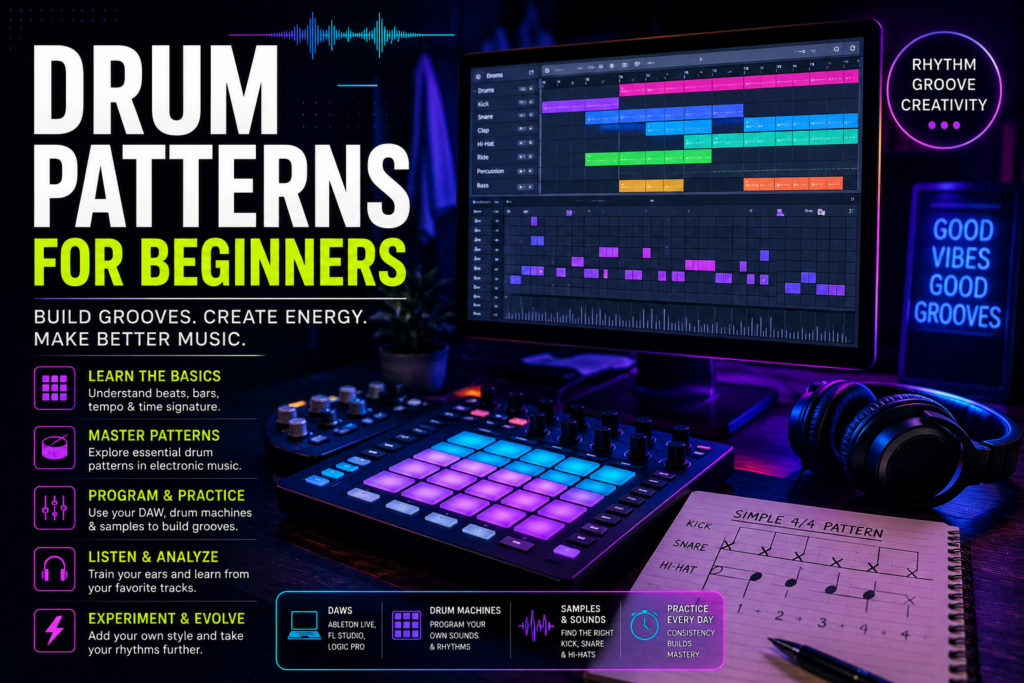
Drum Patterns for Beginners: How to Build Better Rhythms and Improve Your Groove
Whether you’re a drummer, beat maker, or music producer, understanding drum patterns is one of the most important skills you can develop. Drum patterns provide the rhythmic foundation of a song, helping to establish groove, energy, and emotion. From classic rock and blues to modern hip-hop and trap, every genre relies on drum patterns to create movement and keep listeners engaged.
The good news is that learning drum patterns doesn’t have to be complicated. By mastering a few fundamental concepts and techniques, you can begin creating rhythms that sound professional and musical.
In this guide, we’ll explore the basics of drum patterns, essential drumming techniques, common rhythmic structures, listening strategies, and ways to continue developing your skills over time.
Introducing the Basics of Drum Patterns
At their core, drum patterns are repeated rhythmic sequences that provide structure and timing for a piece of music. They determine how beats are organized and played over a specific number of measures.
Think of drum patterns as the framework that supports everything else in a song. While melodies and harmonies often receive the most attention, rhythm is what gives music its pulse.
Why Drum Patterns Matter
Without rhythm, music can feel directionless. A well-crafted drum pattern helps:
- Establish the groove
- Define the genre
- Support other instruments
- Create emotional impact
- Drive the song forward
For example, a simple four-on-the-floor pattern is commonly associated with dance music, while syncopated hi-hat rhythms often characterize hip-hop and trap productions.
Understanding Basic Rhythm Terminology
Before diving deeper, it’s important to understand a few key terms:
Beat: The basic pulse of a song.
Bar (Measure): A group of beats organized according to a time signature.
Tempo: The speed of the music, measured in BPM (beats per minute).
Time Signature: Indicates how many beats are in each bar. The most common time signature is 4/4, meaning four quarter-note beats per measure.
Understanding these concepts provides the foundation needed to learn and create drum patterns effectively.
Creativity Is the Secret Ingredient
While learning standard patterns is important, creativity is what makes your drumming unique. The best drummers and producers don’t simply copy patterns—they adapt them, modify them, and inject their own personality into the groove.
As you learn new rhythms, challenge yourself to experiment with accents, fills, and timing variations.
Exploring Fundamental Drumming Techniques
Strong drum patterns begin with solid technique. Even the simplest groove can sound incredible when executed with precision and consistency.
Single Stroke Roll
The single stroke roll is one of the first techniques every drummer should learn.
Pattern:
R L R L R L R L
This alternating motion develops hand independence and serves as the foundation for countless grooves and fills.
Double Stroke Roll
The double stroke roll introduces two consecutive hits with each hand.
Pattern:
R R L L R R L L
This technique improves control and allows for faster playing at higher tempos.
Paradiddles
Paradiddles combine single and double strokes into one pattern.
Pattern:
R L R R L R L L
Paradiddles help develop coordination and can be applied creatively throughout drum fills and grooves.
Practice Pads: A Beginner’s Best Friend
Practice pads allow drummers to build technique without requiring a full drum kit.
Benefits include:
- Improved stick control
- Better rebound awareness
- Increased endurance
- Quiet practice sessions
Many professional drummers still use practice pads daily to maintain their skills.
Using a Metronome
One of the most valuable tools for any musician is a metronome.
A metronome helps:
- Develop accurate timing
- Improve consistency
- Strengthen internal rhythm
- Build confidence
Start practicing at slower tempos and gradually increase speed as your accuracy improves.
Improving Hand-Foot Coordination
Coordination is often one of the biggest challenges for new drummers.
To improve:
- Practice slowly.
- Break complex patterns into smaller pieces.
- Use repetition consistently.
- Focus on precision before speed.
Remember that even professional drummers developed coordination through thousands of repetitions over time.
Learning Common Drum Patterns and Their Application
Many popular songs rely on surprisingly simple drum patterns.
Learning these foundational grooves can accelerate your musical growth and provide ideas for your own productions.
The Basic 4/4 Rock Beat
The 4/4 rock beat is arguably the most common drum pattern in modern music.
Basic structure:
- Kick drum on beats 1 and 3
- Snare drum on beats 2 and 4
- Hi-hats on every eighth note
This pattern forms the backbone of countless rock, pop, and country songs.
The 12-Bar Blues Pattern
The 12-bar blues pattern is another essential groove.
Blues rhythms emphasize feel and groove rather than technical complexity. Learning blues-based patterns can improve your timing and musical expression significantly.
Applications Across Genres
Many foundational drum patterns appear across multiple genres:
Rock: Strong backbeat and steady pulse.
Pop: Simple, accessible grooves designed to support melodies.
Hip-Hop: Heavy kicks, syncopated snares, and programmed percussion.
Trap: Fast hi-hat rolls, powerful 808s, and sparse drum arrangements.
R&B: Groove-oriented patterns emphasizing feel and pocket.
Understanding how different genres use rhythm can inspire fresh ideas in your own music production.
The Importance of Dynamics
Dynamics refer to the variation between loud and soft notes.
Many beginners focus solely on playing the correct notes, but dynamics often separate amateur performances from professional ones.
Good dynamics create:
- Groove
- Musicality
- Emotional expression
- Greater listener engagement
Practice playing patterns at different volume levels to develop control.
Making Patterns Your Own
Once you’ve learned a groove, experiment with variations.
Try:
- Moving kick drum placements
- Changing hi-hat rhythms
- Adding ghost notes
- Incorporating fills
- Adjusting accents
These small modifications can transform a basic pattern into something uniquely yours.
Developing Listening Skills to Enhance Pattern Recognition
One of the fastest ways to improve as a drummer or producer is through active listening.
The more rhythms you hear and analyze, the larger your internal library of grooves becomes.
Practice Active Listening
Instead of casually listening to music, focus specifically on the drums.
Ask yourself:
- What is the kick drum doing?
- Where is the snare placed?
- How are the hi-hats moving?
- Are there ghost notes?
- What dynamics are being used?
This approach trains your ears to recognize patterns more quickly.
Explore Different Musical Styles
Each genre offers valuable rhythmic lessons.
Spend time studying:
- Rock
- Jazz
- Funk
- R&B
- Hip-Hop
- Gospel
- Latin music
- Electronic music
The broader your musical exposure, the more creative options you’ll have available.
Deconstruct Your Favorite Drum Parts
One effective exercise is recreating grooves from songs you love.
Listen repeatedly and identify:
- Tempo
- Drum sounds
- Pattern structure
- Fill placement
- Dynamic changes
Recreating professional drum parts teaches arrangement concepts that are difficult to learn from theory alone.
Use Technology to Accelerate Learning
Modern technology provides incredible learning opportunities.
Useful tools include:
- Metronome apps
- Drum machine software
- DAWs such as Reason, Ableton Live, and FL Studio
- Slow-down audio software
- Interactive drum-learning platforms
For beat makers and producers, programming drum patterns inside your DAW can also improve your understanding of rhythm and groove.
Engaging in Continuous Learning and Experimentation
Becoming skilled at creating drum patterns is a long-term process.
Consistent practice will always outperform occasional bursts of motivation.
Build a Sustainable Practice Schedule
A simple daily routine might include:
10 Minutes: Rudiments and technique.
10 Minutes: Timing exercises with a metronome.
15 Minutes: Learning new grooves.
15 Minutes: Improvisation and creativity.
Even 30–60 minutes per day can produce significant improvement over time.
Take Advantage of Learning Opportunities
There are more educational resources available today than ever before.
Consider exploring:
- Online drum courses
- YouTube tutorials
- Music production programs
- Drumming workshops
- Community jam sessions
- Local music groups
Learning from experienced musicians can dramatically shorten your learning curve.
Experiment With New Rhythms
Growth happens when you step outside your comfort zone.
Try:
- Unusual time signatures
- Polyrhythms
- Genre crossovers
- Syncopated grooves
- Hybrid acoustic-electronic patterns
Experimentation often leads to the most exciting musical discoveries.
Staying Motivated During Difficult Periods
Every musician experiences plateaus.
When progress feels slow:
- Set smaller goals
- Record your practice sessions
- Celebrate small improvements
- Learn songs you enjoy
- Collaborate with others
Consistency matters more than perfection.
Conclusion
Learning drum patterns is one of the most valuable investments you can make as a drummer, beat maker, or music producer. By understanding rhythm fundamentals, developing proper technique, studying common grooves, strengthening your listening skills, and maintaining a consistent practice routine, you’ll steadily build the foundation needed to create compelling rhythms.
Remember that every great drummer started with basic patterns. Focus on mastering the fundamentals first, then gradually introduce creativity, variation, and experimentation into your playing. Over time, you’ll develop your own unique style and rhythmic voice.
If you’re serious about improving your music production skills, spend time studying drum patterns every day. The grooves you create today can become the foundation of tomorrow’s best tracks.
Recommended Tools for Learning Drum Patterns
Ready to improve your rhythm and groove?
- Explore a quality MIDI controller for finger drumming and beat creation.
- Try professional music production software to program and experiment with drum patterns.
- Invest in a practice pad and metronome for daily skill development.
- Consider online drum and music production courses to accelerate your progress.
The right tools can help you learn faster, stay motivated, and develop professional-level rhythm skills.
Frequently Asked Questions
What is a drum pattern?
A drum pattern is a repeating sequence of rhythmic hits played on a drum kit or programmed in music production software. Drum patterns create the groove and timing foundation of a song.
What is the easiest drum pattern for beginners?
The basic 4/4 rock beat is often considered the easiest drum pattern for beginners because it uses straightforward kick, snare, and hi-hat placements.
How long does it take to learn drum patterns?
Most beginners can learn basic drum patterns within a few weeks. Developing advanced rhythm skills and coordination may take months or years of consistent practice.
Why should I practice with a metronome?
A metronome improves timing, consistency, and rhythmic accuracy, helping you stay locked into the beat.
Can music producers benefit from learning drum patterns?
Absolutely. Understanding drum patterns helps producers create more realistic, musical, and engaging beats regardless of genre.
What genres should I study to improve rhythm?
Rock, funk, jazz, gospel, hip-hop, R&B, Latin, and electronic music all offer valuable rhythmic concepts that can strengthen your overall musicianship.
How can I make my drum patterns more interesting?
Use dynamics, ghost notes, fills, syncopation, and rhythmic variations to create more engaging and unique drum patterns.
Do I need a drum kit to learn drum patterns?
No. Many musicians learn rhythm using practice pads, MIDI controllers, drum machines, and music production software before ever owning a full drum kit.