 10 Beat Arrangement Mistakes That Keep Producers From Finishing Songs
Introduction
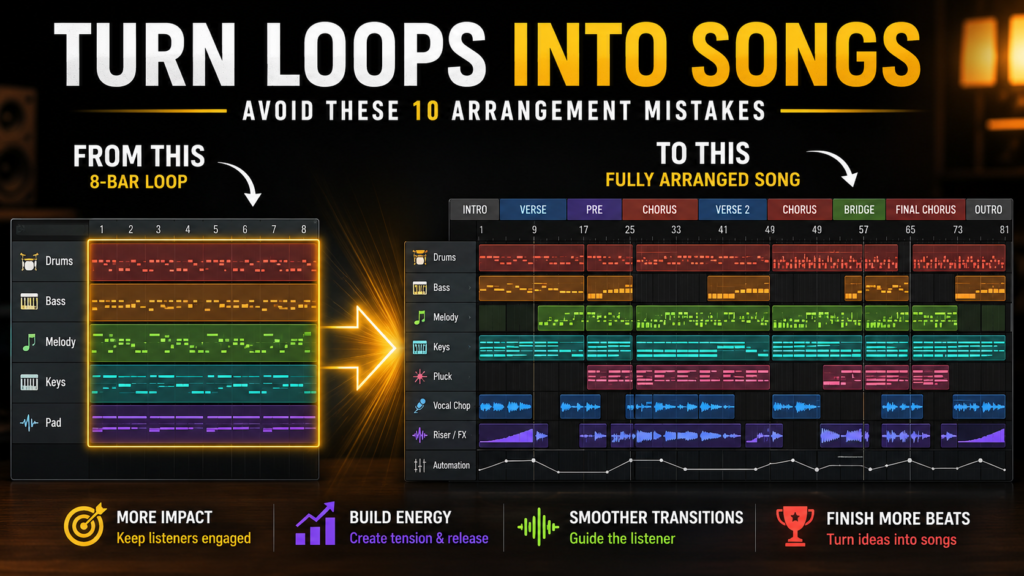
Every music producer knows the feeling. You create an incredible 8-bar loop with hard-hitting drums, a catchy melody, and a deep 808, only to realize you have no idea how to turn it into a complete song. Before long, you save the project, promise yourself you’ll come back later, and start another beat instead.
If this sounds familiar, you’re not alone.
One of the biggest differences between beginner and professional producers isn’t the quality of their sounds—it’s their ability to arrange ideas into finished songs. Great beat arrangement keeps listeners engaged from the intro to the outro by creating movement, excitement, and emotional progression.
In this guide, you’ll learn ten of the most common beat arrangement mistakes and how to avoid them so you can finish more music with confidence.
1. Repeating the Same 8 Bars Over and Over
The most common mistake producers make is allowing the same loop to play for the entire song with little or no variation.
Even if your loop sounds amazing, listeners quickly become accustomed to hearing the same elements repeated. Without changes, the track begins to feel predictable and loses its energy.
How to Fix It
Create subtle variations every four or eight bars by:
- Muting instruments temporarily
- Changing hi-hat patterns
- Adding percussion fills
- Swapping drum sounds
- Introducing new melodies
Small changes keep listeners interested while preserving the identity of your beat.
2. Having No Energy Changes
Professional records constantly build and release energy.
Many unfinished beats remain at the exact same intensity from beginning to end. Without contrast, the listener never experiences anticipation or payoff.
How to Fix It
Think of your arrangement like a movie.
Build excitement before important sections by gradually introducing:
- Additional percussion
- Layered synths
- Bass movement
- Automation
- Drum fills
Then reward the listener with a powerful chorus or beat drop.
3. Forgetting Drum Drops
Sometimes the most impactful drum pattern is no drums at all.
Removing the kick, snare, or entire drum kit for one or two bars creates tension that makes the next section feel much bigger.
Try This
Before every chorus:
- Remove the kick
- Let the melody breathe
- Add a reverse cymbal
- Bring everything back on the downbeat
This simple technique immediately creates excitement.
4. Every Instrument Plays All the Time
If every instrument is playing throughout the entire song, nothing feels special.
Professional arrangements are constantly introducing and removing sounds to create movement.
Less Is More
Instead of stacking every instrument together:
- Let the piano play alone during the intro.
- Bring in the bass during the verse.
- Save additional synth layers for the chorus.
- Remove instruments during transitions.
Giving each instrument room to breathe creates a cleaner, more professional mix.
5. Weak or Nonexistent Transitions
One of the fastest ways to make a beat sound amateur is abrupt section changes.
Professional productions use transition effects to smoothly guide the listener through the arrangement.
Effective Transition Tools
- Reverse cymbals
- White noise risers
- Drum fills
- Pitch effects
- Tape stops
- Filter sweeps
- Vocal chops
- Impact sounds
These effects create anticipation without distracting from the music.
6. The Chorus Doesn’t Feel Bigger
The chorus should be the emotional payoff of your beat.
If your hook sounds exactly like your verse, listeners may not recognize the most important part of the song.
Ways to Make the Chorus Bigger
- Add extra melodies
- Layer additional drums
- Double the bass
- Open low-pass filters
- Increase stereo width
- Add background textures
- Introduce new counter melodies
The goal is to make the chorus feel like a reward.
7. Ignoring Automation
Automation is one of the easiest ways to make a beat sound alive.
Without it, every sound remains static throughout the song.
Automate These Parameters
- Volume
- Filter cutoff
- Reverb
- Delay feedback
- Panning
- Stereo width
- Distortion
- Pitch
Even subtle automation creates movement that keeps listeners engaged.
8. Not Following a Song Structure
Many producers have amazing ideas but no roadmap for organizing them.
Having a basic arrangement template makes finishing songs much easier.
A Simple Beat Structure
- Intro
- Verse
- Pre-Chorus
- Chorus
- Verse 2
- Chorus
- Bridge
- Final Chorus
- Outro
You don’t have to follow this structure exactly, but having a framework helps prevent creative roadblocks.
9. Ignoring Dynamics
Dynamics are the differences between loud and quiet moments.
If every section has the same volume, instrumentation, and intensity, the song becomes exhausting to listen to.
Create Contrast By
- Lowering instrument count
- Reducing drum intensity
- Changing velocity
- Using quieter intros
- Building toward louder choruses
Contrast is what makes big moments feel big.
10. Calling the Beat Finished Too Soon
One of the biggest mistakes producers make is exporting a beat the moment it feels “good enough.”
Professional producers revisit their work with fresh ears before releasing it.
Final Arrangement Checklist
Before exporting, ask yourself:
- Does every section feel different?
- Is the chorus bigger than the verse?
- Are there enough transitions?
- Does the energy continue building?
- Are unnecessary instruments muted?
- Does anything become repetitive?
- Does the ending feel intentional?
If you answer “no” to any of these questions, spend a little more time refining the arrangement.
Final Thoughts
Great beat arrangement isn’t about adding more sounds—it’s about making intentional decisions that guide the listener through the music.
The producers you admire aren’t necessarily creating better loops. They’re creating better experiences by carefully managing energy, dynamics, transitions, and structure from start to finish.
The next time you open your DAW, challenge yourself to finish one beat instead of starting three new ones. Every completed project builds experience, improves your workflow, and moves you one step closer to producing music that sounds truly professional.
Remember, finished beats always have more value than unfinished ideas.