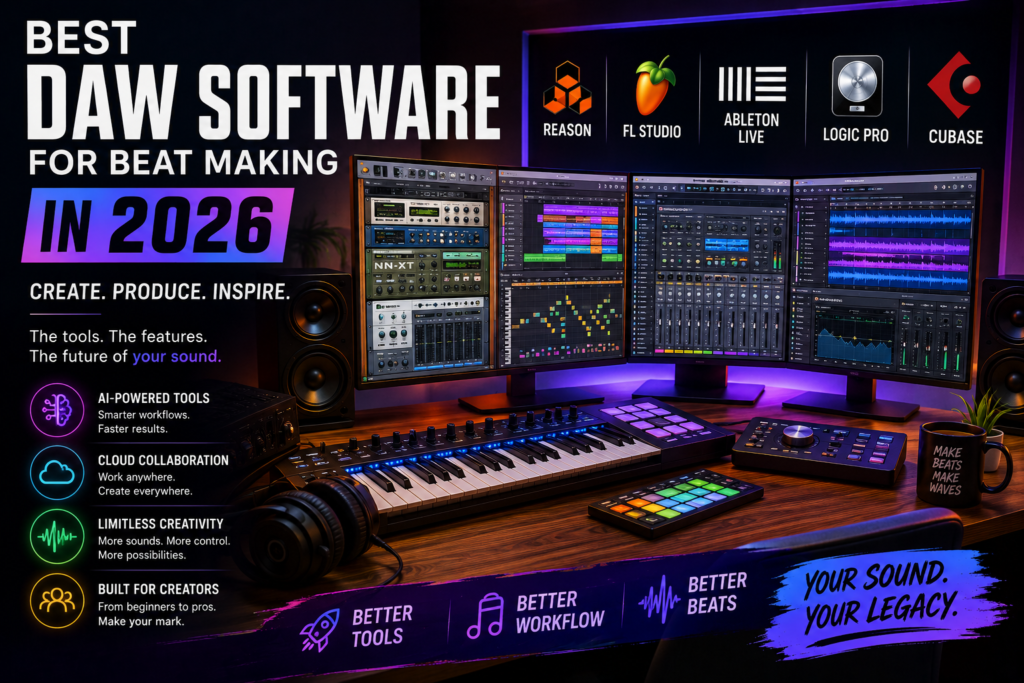
 The world of music production continues to evolve at an incredible pace, and nowhere is that more evident than in the development of Digital Audio Workstations (DAWs). Whether you’re making trap beats in your bedroom, producing R&B records for artists, or building a professional studio, your DAW serves as the foundation of your entire creative process.
In 2026, producers have more powerful options than ever before. Modern DAWs offer advanced audio engines, AI-assisted tools, cloud collaboration, and workflows designed to help creators move from idea to finished track faster than ever. But with so many choices available, finding the right DAW can feel overwhelming.
In this guide, we’ll explore the evolution of DAW software, examine the best options available in 2026, discuss emerging technologies shaping the future of music production, and help you choose the right DAW for your beat-making journey.
The Evolution of DAW Software in Beat Making
From Hardware Studios to Digital Production
Before DAWs became mainstream, music production required expensive hardware studios filled with tape machines, mixing consoles, samplers, and outboard processors. Producing professional music was often limited to major studios and industry professionals.
The introduction of computer-based recording systems changed everything. Early DAWs offered basic recording and editing capabilities, but they quickly evolved into complete production environments capable of handling every aspect of music creation.
As computing power increased, DAWs became more accessible, more affordable, and significantly more powerful.
Why DAWs Matter in Modern Music Production
Today, virtually every commercial record begins and ends inside a DAW.
Modern DAWs allow producers to:
- Record vocals and instruments
- Program drums and percussion
- Create MIDI arrangements
- Mix and master tracks
- Collaborate remotely
- Integrate virtual instruments and effects
For beat makers, the DAW has become the central hub for creativity and workflow.
Democratizing Music Creation
One of the most important impacts of DAW technology is accessibility.
A producer with a laptop, headphones, and a DAW can now create music that competes with major-label releases. This democratization has allowed millions of creators worldwide to share their music without needing access to expensive recording studios.
Platforms like YouTube, BeatStars, Spotify, and TikTok have further amplified this movement, allowing independent producers to build careers directly from their home studios.
Top DAW Software for 2026: Features & Highlights
Reason 14
Reason continues to stand out as one of the most unique DAWs available.
Known for its virtual rack system, Reason provides producers with an inspiring environment that closely resembles working with hardware equipment.
Key Features:
- Virtual rack workflow
- Powerful stock instruments
- Exceptional sound design tools
- Flexible routing system
- Strong MIDI capabilities
Best For:
- Sound designers
- Hip-hop producers
- R&B producers
- Creators who enjoy experimentation
Ableton Live 13
Ableton Live remains a favorite among electronic music producers and live performers.
Its Session View offers a workflow unlike any other DAW, making it ideal for idea generation and creative experimentation.
Key Features:
- Session and Arrangement Views
- Advanced warping technology
- Max for Live integration
- Powerful MIDI tools
- AI-assisted workflow enhancements
Best For:
- Electronic music
- Live performers
- Experimental producers
FL Studio 25
FL Studio continues to dominate among beat makers and hip-hop producers.
Its intuitive pattern-based workflow allows beginners to start making beats quickly while providing enough depth for professional production.
Key Features:
- Step sequencer
- Piano Roll
- Lifetime free updates
- Extensive plugin bundle
- Easy workflow for beginners
Best For:
- Trap producers
- Hip-hop beat makers
- Beginner producers
Logic Pro
For Mac users, Logic Pro remains one of the best values in music production.
Apple continues to add advanced features while maintaining an affordable one-time purchase model.
Key Features:
- Massive sound library
- AI-powered session tools
- Professional mixing environment
- Advanced MIDI editing
- Integrated mastering tools
Best For:
- Singer-songwriters
- Pop producers
- Full-scale music production
Cubase 15
Cubase remains one of the most technically advanced DAWs available.
Many professional composers, producers, and engineers rely on Cubase for its deep feature set.
Key Features:
- Advanced MIDI editing
- Professional scoring tools
- Audio alignment technology
- Comprehensive mixing environment
Best For:
- Composers
- Advanced producers
- Studio professionals
What Makes Modern DAWs Different?
Artificial Intelligence Integration
AI is becoming a major part of modern music production.
Today’s DAWs increasingly include:
- Intelligent mix assistants
- Chord generation tools
- Audio cleanup features
- Automated mastering suggestions
- Arrangement assistance
These tools help beginners achieve professional results faster while giving experienced producers new creative possibilities.
Cloud Collaboration
The modern music industry is more connected than ever.
Cloud-based features allow producers to:
- Share sessions instantly
- Collaborate across continents
- Access projects from multiple devices
- Backup work automatically
This has transformed how artists and producers work together.
Enhanced User Experience
Modern DAWs focus heavily on workflow efficiency.
Developers continue to improve:
- User interfaces
- Navigation systems
- Plugin management
- CPU optimization
- Project organization
The goal is simple: remove technical barriers and allow creativity to flow freely.
Empowering Creators: DAWs and Unlimited Creativity
Building Complete Productions from Scratch
Today’s DAWs provide everything needed to create professional music.
A producer can:
- Program drums
- Create melodies
- Record vocals
- Mix tracks
- Master songs
- Export commercial releases
All without leaving the software environment.
Success Stories from Modern Producers
Many of today’s biggest producers started with little more than a laptop and a DAW.
Artists and producers across genres have built successful careers using:
- FL Studio
- Ableton Live
- Logic Pro
- Reason
- Cubase
Their success demonstrates that creativity matters more than expensive equipment.
Personal Growth Through DAW Mastery
Every producer develops a unique relationship with their chosen DAW.
Beginners often focus on learning technical skills, while experienced producers eventually reach a point where the DAW becomes nearly invisible, allowing ideas to flow naturally.
The best DAW is often the one that inspires you to create consistently.
Future Trends: The Next Wave of Innovation in DAWs
Artificial Intelligence as a Creative Partner
Future DAWs will likely use AI not just for technical tasks but also for creative assistance.
Potential developments include:
- Intelligent arrangement suggestions
- Automatic sound design assistance
- Real-time composition support
- Personalized workflow recommendations
AI will likely become a creative collaborator rather than simply an automation tool.
Virtual Reality Music Production
Although still in its early stages, VR technology may eventually transform music creation.
Future producers could interact with:
- Virtual mixing consoles
- 3D sound environments
- Immersive studio spaces
- Gesture-based editing systems
While mainstream adoption may take time, the potential is enormous.
Global Collaboration Without Boundaries
The future of music production is increasingly global.
Producers in different countries can already collaborate instantly, and future DAW platforms will likely make these workflows even more seamless.
This global connectivity continues to fuel innovation and creativity across genres.
Making the Right Choice: How to Select Your Ideal DAW
Consider Your Musical Goals
Before choosing a DAW, ask yourself:
- What genres do I produce?
- Do I perform live?
- Will I record vocals?
- Do I prefer hardware or software workflows?
Your answers will help narrow the options.
Evaluate Workflow Over Features
Many producers make the mistake of comparing feature lists.
In reality, workflow matters more.
A DAW with fewer features but a workflow you enjoy will often lead to greater productivity and better music.
Take Advantage of Free Trials
Most major DAWs offer free trials.
Spend time creating actual projects rather than simply exploring menus.
This provides the clearest picture of whether a DAW fits your creative process.
Optimize Your Production Environment
Once you’ve selected a DAW:
- Learn keyboard shortcuts
- Organize templates
- Create custom workflows
- Build reusable project files
- Develop a consistent production system
Small improvements compound over time and dramatically increase productivity.
Final Thoughts
The DAW landscape in 2026 is more exciting than ever. Whether you choose Reason, FL Studio, Ableton Live, Logic Pro, or Cubase, today’s software provides extraordinary creative possibilities that were unimaginable just a decade ago.
The truth is that no DAW will make you a great producer on its own. Success comes from consistent practice, experimentation, and developing a workflow that keeps you inspired to create.
Choose the DAW that feels intuitive, learn it deeply, and focus on making music. The tools have never been more powerful—the next great beat could be only a few clicks away.