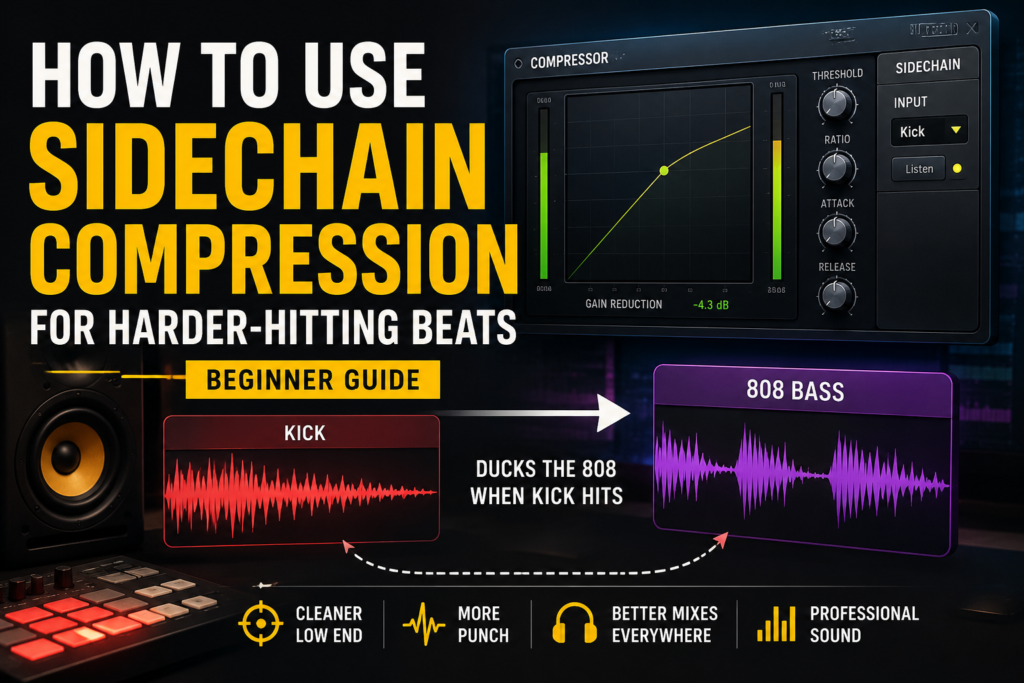
 If you’ve ever wondered why professional hip-hop and R&B beats sound punchy, clean, and powerful—even with heavy 808s—the answer often comes down to one technique: sidechain compression.
While it may seem like an advanced mixing trick, sidechain compression is actually one of the easiest ways to create space in a mix. Whether you’re producing trap, drill, R&B, pop, or electronic music, learning how to use sidechain compression can instantly improve the clarity and impact of your beats.
In this guide, you’ll learn what sidechain compression is, why it matters, and exactly how to use it to create cleaner mixes and harder-hitting drums.
What Is Sidechain Compression?
Sidechain compression is a technique where one audio signal controls the compression of another.
Instead of a compressor reacting to the track it’s placed on, it reacts to a completely different sound.
The most common example is:
- Kick drum triggers the compressor
- Compressor lowers the volume of the 808 bass
- The kick punches through clearly
- The 808 immediately returns after the kick
The result is a cleaner low end without sacrificing bass energy.
Think of it like two people trying to speak at the same time. Sidechain compression lets one person briefly pause so the other can be heard clearly.
Why Every Beat Maker Should Learn Sidechain Compression
Many beginner producers try to solve muddy mixes by turning sounds down or boosting EQ.
While EQ is important, it can’t always solve frequency masking.
Sidechain compression creates space dynamically, only when it’s needed.
Benefits include:
- Cleaner low-end mixes
- More powerful kick drums
- Better 808 definition
- Increased headroom
- Louder masters with less distortion
- More professional-sounding beats
Even subtle sidechain compression can make a dramatic difference.
Understanding Frequency Masking
One reason kicks and 808s often clash is because they occupy many of the same frequencies.
Typical frequency ranges include:
- Kick fundamentals: 40–100 Hz
- 808 fundamentals: 30–80 Hz
When both hit simultaneously, they compete for space.
The result can be:
- Muddy bass
- Weak kick
- Distortion
- Reduced punch
- Poor translation on headphones and speakers
Sidechain compression briefly lowers the bass only while the kick plays, allowing both sounds to remain powerful.
How To Sidechain Your Kick and 808
The kick-to-808 relationship is the most common use of sidechain compression.
Here’s a simple workflow.
Step 1: Insert a Compressor
Place a compressor on your 808 track.
Step 2: Choose the Kick as the Sidechain Input
Most DAWs allow you to select an external audio source.
Choose your kick drum.
Now every kick hit will trigger the compressor.
Step 3: Adjust the Threshold
Lower the threshold until the compressor activates whenever the kick plays.
Don’t worry about exact numbers.
Use your ears.
Step 4: Set the Ratio
A ratio between:
- 2:1
- 4:1
works well for most hip-hop beats.
Higher ratios create stronger ducking.
Step 5: Dial in Attack
For kick and bass:
Attack should usually be fast.
A fast attack allows the kick to immediately create space.
Step 6: Adjust Release
Release controls how quickly the bass returns.
Too fast:
- pumping sounds unnatural
Too slow:
- bass disappears too long
Match the release to your song’s tempo for the smoothest result.
Recommended Starting Settings
Every mix is different, but these settings are an excellent starting point.
| Setting | Suggested Value |
|---|---|
| Ratio | 3:1 |
| Attack | 2–10 ms |
| Release | 60–120 ms |
| Threshold | Lower until the kick ducks the bass naturally |
| Gain Reduction | 2–5 dB |
Avoid chasing exact numbers.
Listen for a natural balance where the kick becomes clearer without making the bass disappear.
Creative Uses Beyond Kick and 808
Sidechain compression isn’t limited to low-end mixing.
Professional producers use it throughout a session.
Pads
Duck atmospheric pads slightly under vocals to improve vocal clarity.
Piano
Allow lead melodies to cut through sustained piano chords.
Reverb
Duck the reverb while vocals play.
This creates cleaner vocals while maintaining a spacious mix.
Delay
Many modern vocal chains sidechain delay effects so echoes become louder only after the vocal phrase ends.
Synths
Dance and pop producers often exaggerate sidechain compression for the signature pumping effect heard in many club records.
Common Sidechain Compression Mistakes
Using Too Much Compression
Heavy ducking can make the bass sound unnatural.
Subtle movement often sounds more professional.
Ignoring Song Tempo
Release time should complement the groove.
If the release is too slow or too fast, the mix can lose its rhythm.
Compressing Everything
Not every instrument needs sidechain compression.
Use it intentionally.
Forgetting Gain Staging
Sidechain compression works best when your mix is already balanced.
If levels are wildly inconsistent, compression won’t solve the underlying issue.
Using Sidechain Instead of EQ
Compression and EQ serve different purposes.
EQ removes frequency buildup.
Sidechain compression creates temporary space.
Using both together often produces the cleanest results.
Best Plugins for Sidechain Compression
Fortunately, you don’t need expensive software to achieve professional results.
Most stock DAW compressors support sidechain routing.
Popular options include:
- Ableton Live Compressor
- Logic Pro Compressor
- FL Studio Fruity Limiter
- Reason MClass Compressor and other compatible devices
- Cubase Compressor
- Studio One Compressor
If you want even more control, dedicated volume-shaping plugins can create extremely transparent ducking effects without traditional compression.
Tips for Better Results
- Let the kick remain the loudest element in the low end.
- Sidechain only as much as necessary.
- Match release time to the song’s groove.
- Always compare before and after.
- Check your mix on headphones and speakers.
- Trust your ears more than plugin presets.
Remember, professional mixes often rely on subtle improvements rather than dramatic effects.
Final Thoughts
Sidechain compression is one of the most valuable techniques every beat maker should master.
It helps create cleaner mixes, stronger kicks, tighter bass, and more professional-sounding productions without drastically changing your sound.
The key is moderation. A few decibels of gain reduction, paired with thoughtful EQ and proper gain staging, can transform a muddy beat into a polished, radio-ready production.
As your mixing skills improve, you’ll discover that sidechain compression isn’t just a technical tool—it’s a creative one. Used wisely, it adds movement, clarity, and energy that helps your music compete with today’s professional releases.
By practicing this technique consistently, you’ll build mixes that hit harder, translate better across different playback systems, and give every element in your beat the space it deserves.