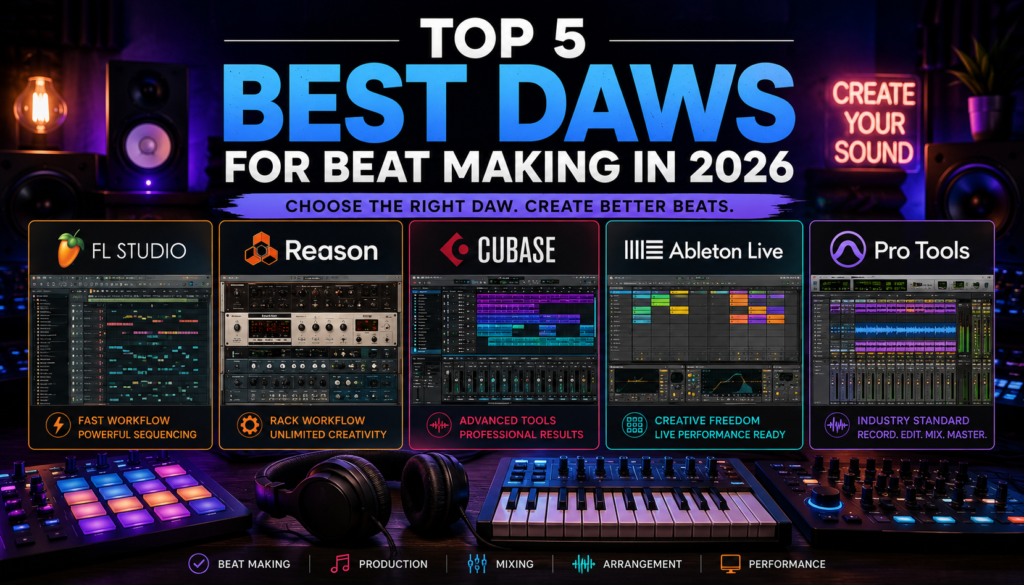
 Introduction to the Evolving Landscape of Digital Audio Workstations (DAWs)
If you’re serious about making beats, choosing the right Digital Audio Workstation (DAW) is one of the most important decisions you’ll make. Your DAW becomes your creative home—the place where drums hit, melodies come alive, and rough ideas become polished tracks.
Whether you’re producing hip-hop, trap, R&B, pop, or EDM, the DAW you choose directly impacts your workflow, speed, and creativity.
What Is a DAW?
A Digital Audio Workstation is software used for recording, arranging, editing, mixing, and mastering music.
DAWs allow producers to:
- Program drums
- Record vocals
- Chop samples
- Mix songs
- Export finished tracks
Today’s DAWs are incredibly powerful, offering tools that rival million-dollar studios from past decades.
Brief History and Evolution of DAWs
Music production has changed dramatically.
In the past, producers relied on:
- Hardware samplers
- Tape machines
- Mixing consoles
- Drum machines
Modern DAWs now combine all of those functions into software.
This shift has made music production more accessible than ever.
Criteria for Choosing a DAW
When choosing a DAW, consider:
User Interface
Is the layout intuitive?
Workflow
Does it help you create quickly?
Features
Does it include the tools you need?
Price
Can it fit your budget?
Now let’s explore the top DAWs for beat making in 2026.
1. FL Studio: A Powerhouse for Creativity
Few DAWs have influenced modern beat making like FL Studio.
Originally known as FruityLoops, FL Studio has become the go-to DAW for countless chart-topping producers.
Main Features
FL Studio excels at:
- Drum programming
- Piano roll editing
- Melody creation
- Loop-based production
- Pattern sequencing
Its legendary piano roll remains one of the best in the industry.
Why Beat Makers Love FL Studio
FL Studio is especially popular among:
- Hip-hop producers
- Trap producers
- Drill producers
- Bedroom creators
Why?
Because ideas happen fast.
You can go from blank session to full beat quickly.
Success Stories
Many elite producers started in FL Studio.
Notable names include:
- Metro Boomin
- Murda Beatz
- Southside
That alone says a lot.
2026 Updates
FL Studio continues improving with:
- Better AI-assisted workflow
- Improved stem separation
- Faster browser navigation
- Enhanced plugin performance
Verdict: If your priority is fast beat creation, FL Studio is hard to beat.
2. Reason: The All-in-One Studio Solution
Reason offers one of the most unique production experiences available.
Instead of traditional software design, Reason feels like a virtual hardware studio.
Key Features for Beat Making
Reason shines in:
- Sound design
- Synth programming
- Routing flexibility
- Sampling
- Rack-style workflow
Its visual rack encourages experimentation.
For creative producers, that’s powerful.
Rack Extensions
One of Reason’s biggest strengths is Rack Extensions.
These modules allow you to customize your studio with:
- Synths
- Compressors
- EQs
- Effects
- Creative processors
This makes Reason extremely flexible.
Collaboration Benefits
Modern producers often collaborate remotely.
Reason supports collaboration through:
- Stem exports
- Plugin support
- Rack Plugin integration
You can even use Reason devices inside other DAWs.
That’s huge.
2026 Outlook
Reason remains strong thanks to:
- Improved browser workflow
- Better VST integration
- Enhanced devices
- Expanded sampling tools
Verdict: If you love deep creativity and sound design, Reason is elite.
3. Cubase: The Comprehensive Music Production Suite
Cubase is one of the most professional and feature-rich DAWs available.
It’s often underrated in beat-making conversations.
That’s a mistake.
Professional Tools
Cubase includes:
- Advanced MIDI editing
- Chord tools
- AudioWarp
- VariAudio
- High-end mixing tools
Its MIDI capabilities are especially impressive.
Creativity Benefits
Cubase helps producers with:
- Chord generation
- Harmonic experimentation
- Arrangement tools
- Complex compositions
This makes it excellent for producers who value musical depth.
Pros for Beginners
- Excellent MIDI workflow
- Powerful stock plugins
- Deep composition tools
Cons for Beginners
- Steeper learning curve
- More complex UI
- Can feel overwhelming initially
2026 Future
Cubase continues improving with:
- AI assistance
- Better workflow enhancements
- Improved orchestral features
Verdict: Ideal for serious producers who want advanced control.
4. Ableton Live: Innovation and Speed
Ableton changed production forever.
Its non-linear workflow makes idea generation incredibly fast.
Standout Features
Ableton excels at:
- Live performance
- Sampling
- Loop manipulation
- Sound design
- Experimental production
Its Session View is legendary.
Why Producers Love It
Ableton encourages experimentation.
You can:
- Rearrange ideas instantly
- Warp audio effortlessly
- Build creative textures fast
This makes it a favorite among forward-thinking producers.
Professional Use
Ableton dominates in:
- EDM
- Experimental music
- Live performance
- Sample-heavy genres
Verdict: Incredible for producers who value speed and experimentation.
5. Pro Tools: The Industry Recording Standard
Pro Tools remains the king of professional recording studios.
While it isn’t usually the first choice for beat making, it dominates audio engineering.
Core Strengths
Pro Tools excels at:
- Recording
- Editing
- Vocal production
- Mixing
- Mastering
Its editing precision is world-class.
Why Professionals Choose Pro Tools
Top engineers use Pro Tools because of:
- Stability
- Editing speed
- Studio compatibility
- Session portability
If you plan to work in major studios, learning Pro Tools helps.
Verdict: Best for engineering-heavy workflows.
Ableton Live vs Pro Tools: Side-by-Side
| Category | Ableton Live | Pro Tools |
|---|---|---|
| Beat Making | Excellent | Good |
| Recording | Good | Elite |
| Mixing | Great | Elite |
| Creativity | Elite | Good |
| Live Performance | Elite | Limited |
Both are excellent—but designed for different producers.
Which DAW Is Best for You?
Choose based on your goals.
Choose FL Studio if:
Choose Reason if:
You love sound design and creative routing.
Choose Cubase if:
You want deep composition tools.
Choose Ableton Live if:
You value speed and experimentation.
Choose Pro Tools if:
You prioritize recording and mixing.
Final Thoughts
The truth is simple:
There is no universally “best” DAW.
Only the best DAW for you.
Every DAW on this list can produce Grammy-worthy records.
The real differentiator isn’t the software—it’s the producer behind it.
Choose one.
Learn it deeply.
Create consistently.